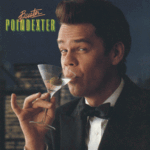
 In a decade overflowing with big hair, neon suits, synthesizers, and over-the-top personas, few characters embodied the theatrical fun of the 1980s quite like Buster Poindexter. With his towering pompadour, tailored suits, martini-bar swagger, and booming baritone voice, Buster was the kind of performer who felt like he’d stepped out of a smoky nightclub in 1957 and crash-landed smack into the high-gloss world of MTV. But behind the swagger and the jokey stage persona was one of rock’s hardest working frontmen: David Johansen, the former lead singer of The New York Dolls. Reinvention was nothing new to him—but Buster Poindexter became the reinvention that most of America would end up knowing best.
The Unlikely Birth of a Cocktail-Lounge Superstar
By the mid-1980s, David Johansen had already lived a full musical lifetime. As the frontman of the New York Dolls in the early 1970s, he helped blaze the trail for punk, glam, and the entire alternative rock movement that followed. But while critics adored the Dolls, mainstream America didn’t fully get the band’s chaotic brilliance until years later. After the Dolls fizzled, Johansen reinvented himself as a solo rock artist, releasing several albums and steadily touring.
Then came the persona that would change everything.
Buster Poindexter wasn’t born as a record label plan or a corporate stylist’s invention. He emerged from Johansen’s love for the music he grew up with—jump blues, calypso, big band, and the kind of songs you’d hear at a sweaty Saturday night bar where the band knew how to make people dance. It was music full of humor, rhythm, and spectacle. Johansen began performing these songs live with his band, and the Buster character took shape naturally. Soon enough, he embraced it fully: slick suits, a sharper-than-sharp hairdo, and that big personality that lit up every stage he walked onto.
“Hot Hot Hot” — The Song That Set the ’80s on Fire
If you were alive and conscious in the late 1980s, you heard Buster Poindexter’s voice everywhere—at parties, in bars, at sporting events, and on MTV. His 1987 hit “Hot Hot Hot” became one of the most unavoidable songs of the decade. Infectious, goofy, wildly danceable, and impossible not to sing along with, it made Buster Poindexter a household name almost instantly.
Ironically, Johansen later joked that the song felt like a “curse,” because he couldn’t escape it. No matter where he went, people shouted “Hot Hot Hot!” at him. Still, the song cemented his place in pop culture. It was one of those rare tracks that transcended genre and audience—it was equally beloved at weddings, college parties, and backyard barbecues for generations to come.
But Buster Poindexter was not a one-note novelty act. His catalog was full of clever covers, bold horn arrangements, and a knowing sense of humor that made his albums feel like stepping into a late-night lounge full of mischief and charm.
A Persona Built on Wit, Style, and Showmanship
Part of what made Buster Poindexter so appealing was the confidence and theatricality of the character. This was not David Johansen pretending to be someone else—this was a side of him amplified to cartoonish perfection. Buster cracked jokes with the crowd, sipped cocktails between songs, and belted out numbers with the gusto of an old-school showman who knew exactly how to work a room.
His shows felt like a time warp. You got calypso rhythms, bluesy shuffles, soul, big-band bombast, and sly humor all mixed into one engaging, sweaty stage performance. It was revivalism, but with a wink. This wasn’t nostalgia—it was reinvention.
MTV Loved Him (And He Loved It Right Back)
While many ’80s artists embraced music videos as flashy visual commercials for their songs, Buster Poindexter used MTV as a stage. His videos showed off his playful side, capturing the full persona: the tuxedoed entertainer, the smooth-talking lounge singer, the slightly rowdy bar-band frontman. Everything about him translated perfectly to the visual medium—his expressions, his gestures, his pompadour, even the way he leaned into the microphone.
MTV was the megaphone that sent Buster Poindexter into every living room in America. Kids who had never heard of the New York Dolls suddenly knew David Johansen as the guy who sang “Hot Hot Hot” while dancing around in a suit.
Albums Full of Party Spirit and Musical Depth
Although “Hot Hot Hot” became the unavoidable hit, the albums surrounding it were rich, layered, and full of musical surprises. Buster covered classic R&B, jump blues, and calypso tracks with a full horn section that gave his music a bold, theatrical energy. Songs like “Screwy Music,” “Heart of Gold,” “Bad Boy,” and his version of “House of the Rising Sun” showed that the project wasn’t just a novelty. It was a genuine celebration of musical history.
What made the music stand out was Johansen’s voice—powerful, expressive, and seasoned by years of rock ’n’ roll grit. The Buster Poindexter persona let him use that voice in new ways, bringing humor and swagger to songs that might otherwise have felt old-fashioned.
From MTV to the Big Screen
The success of Buster Poindexter also led to Johansen appearing in movies and television throughout the late ’80s and early ’90s. Most famously, he appeared in the 1988 holiday classic Scrooged, playing the memorable Cab Driver—wild-eyed, chaotic, hilarious, and unmistakably channeling the Buster energy.
This crossover appeal helped solidify Buster Poindexter as more than just a singer—he was a pop-culture character.
A Persona That Never Fully Disappeared
Buster Poindexter didn’t remain Johansen’s sole focus forever, but the character never died either. Over the years, he occasionally revived the persona for performances, recordings, and special appearances. Fans still flock to see him when he brings the character back to life onstage.
The legacy of Buster Poindexter is best understood not through chart positions, but through memory. He was part of the soundtrack of parties, weddings, and summer nights. He was the soundtrack of pure fun. And he gave ’80s culture one of its most memorable characters—a performer who blended sophistication and silliness in a way only David Johansen could pull off.
Why Buster Poindexter Still Matters
In an era full of pop stars who took themselves very seriously, Buster Poindexter was a reminder that music could be joyful, theatrical, and unashamedly fun. He celebrated the past while making it feel fresh. He gave the world one of the great party anthems of all time. And he proved that reinvention isn’t just possible—it can become the defining moment of a long, remarkable career.
Behind the pompadour and punchlines was a musician who loved entertaining people. And that love made Buster Poindexter not just an ’80s figure, but a timeless one.
This post has already been read 2924 times!