Bright orange tracks stretched across living room floors. Tiny die-cast cars flew through loops, jumped ramps, and crashed into elaborate obstacle courses built from imagination more than instruction manuals. For millions of children growing up during the 1970s, 1980s, and beyond, Hot Wheels were more than just toy cars—they were a hobby, a collection, and often an obsession.
More than half a century after their debut, Hot Wheels remains one of the most successful toy brands ever created. With billions of cars produced and countless playsets released, the brand has become a staple of childhood across multiple generations. While many toys come and go with changing trends, Hot Wheels has managed to stay relevant by constantly evolving while never abandoning the simple concept that made it famous: small, affordable cars built for speed and imagination.
A Challenger to Matchbox
Before Hot Wheels arrived, Matchbox dominated the die-cast toy car market. Introduced in the 1950s, Matchbox cars were admired for their realistic appearance and detailed designs. Children loved them, but there was one thing they weren’t really designed to do—race.
Mattel recognized an opportunity.
The company wanted to create toy cars that were not only attractive but could actually perform. Engineers designed vehicles with thinner axles and special low-friction wheels that dramatically reduced rolling resistance. The result was a toy that could travel farther and faster than anything children had experienced before.
When Hot Wheels debuted in 1968, they immediately stood apart from every competitor.
The Original “Sweet 16”
The first Hot Wheels lineup featured sixteen vehicles that collectors now refer to as the “Sweet 16.”
Unlike traditional toy cars, these vehicles looked like customized hot rods and muscle cars. Many featured oversized engines, flashy paint jobs, racing stripes, and bright colors inspired by California’s custom car culture.
Among the originals were favorites such as:
- Camaro
- Custom Mustang
- Deora
- Custom Cougar
- Beatnik Bandit
- Ford J-Car
- Silhouette
Today, original Sweet 16 cars remain some of the most valuable Hot Wheels collectibles ever produced.
Speed Was Everything
The defining feature of Hot Wheels wasn’t simply how they looked—it was how they moved.
Mattel introduced orange plastic track sections that snapped together, allowing children to create racecourses almost anywhere. Gravity-powered hills, boosters, loops, jumps, and banked curves transformed a bedroom into a miniature raceway.
Unlike many competing toy lines, Hot Wheels encouraged experimentation.
Children discovered that changing the angle of a ramp or adding another loop could completely alter the outcome of a race. The toys blended creativity with basic engineering concepts without ever feeling educational.
Every race became an experiment.
A Perfect Toy for the 1980s
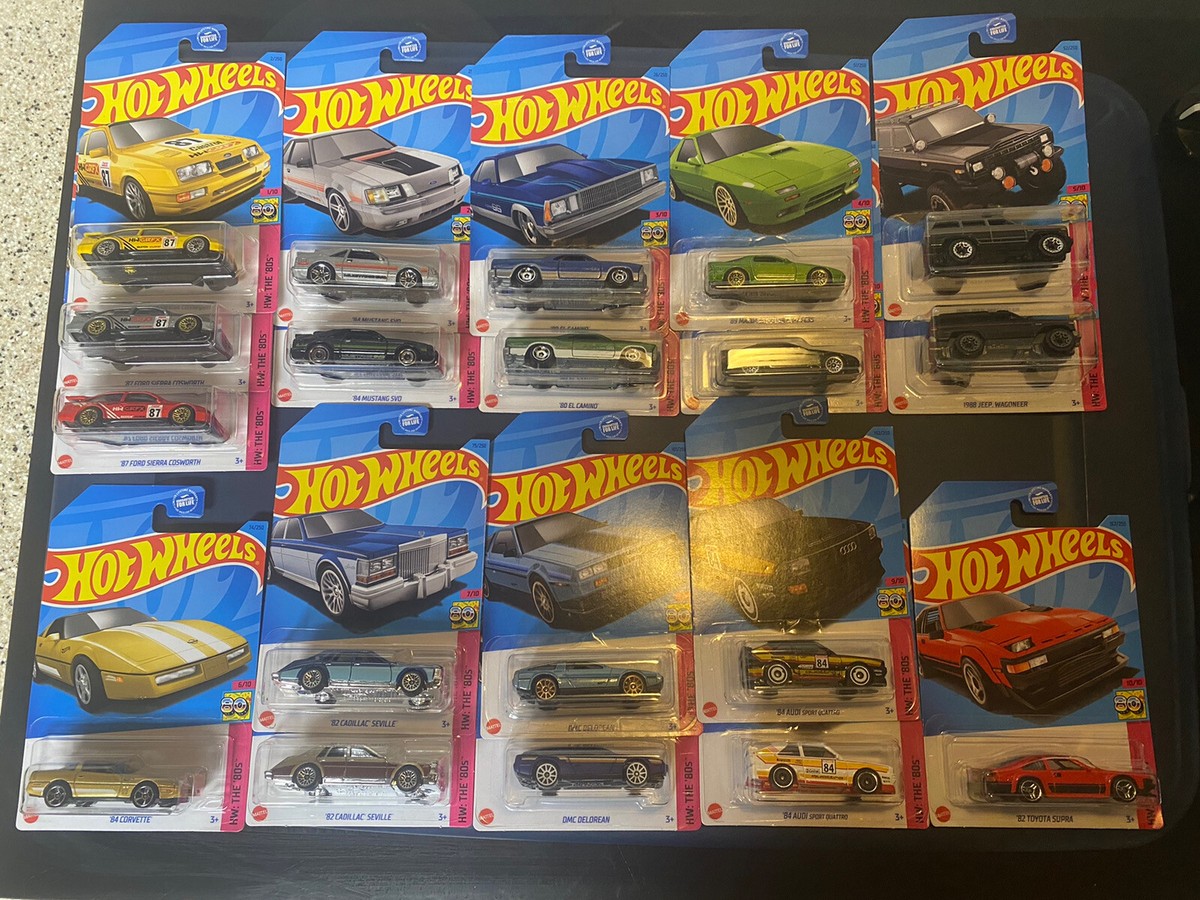
Although Hot Wheels had already been around for over a decade when the 1980s began, the decade proved to be one of the brand’s biggest growth periods.
The 1980s celebrated speed, bright colors, and extreme designs. Sports cars became more angular. Race cars became more aerodynamic. Television featured programs like Knight Rider and The Dukes of Hazzard, while blockbuster films showcased Ferraris, Lamborghinis, and futuristic concept vehicles.
Hot Wheels reflected that excitement.
Shelves filled with Corvettes, Ferraris, Lamborghinis, Porsches, monster trucks, fantasy racers, and outrageous concept vehicles painted in electric blues, neon greens, metallic reds, and brilliant yellows.
Many children eagerly anticipated each trip to the toy aisle, hoping to find a model they didn’t already own.
Affordable Collecting
One of Hot Wheels’ greatest strengths has always been affordability.
Unlike larger action figures or electronic toys, a single Hot Wheels car cost little enough that parents could often buy one during an ordinary shopping trip.
Birthdays and holidays might bring elaborate race tracks or carrying cases, but even a single new car felt exciting.
This low price point encouraged collecting.
Many children organized their vehicles by color, manufacturer, or racing number. Others invented elaborate stories involving police pursuits, demolition derbies, or endurance races across the carpet.
Before long, shoe boxes, tackle boxes, and carrying cases were filled with dozens—or even hundreds—of tiny vehicles.
More Than Real Cars
Although Hot Wheels has always featured licensed vehicles from companies like Ford, Chevrolet, Dodge, Ferrari, Porsche, and Lamborghini, the brand also became famous for cars that existed only in imagination.
Designers created fantasy vehicles that looked impossible in the real world.
Massive exposed engines.
Rocket-powered dragsters.
Jet-inspired racers.
Alien-looking concept cars.
These imaginative creations often became just as beloved as replicas of real automobiles because they encouraged children to invent their own worlds rather than simply recreate reality.
Track Sets That Kept Growing
Every few years, Mattel introduced new ways to play.
Looping tracks became larger.
Motorized boosters kept races going continuously.
Crash intersections sent cars flying into spectacular pileups.
Multi-level garages allowed children to store growing collections.
Launchers fired vehicles at incredible speeds.
Entire cities could be built using modular track pieces that connected together in dozens of different configurations.
The possibilities seemed endless.
Even if two children owned identical track sets, no two layouts were ever exactly alike.
The Rise of Adult Collectors
What surprised many people was that children weren’t the only fans.
By the late 1980s and especially during the 1990s, adults who had grown up with Hot Wheels began collecting them seriously.
Limited editions.
Convention exclusives.
Factory errors.
Rare paint colors.
Short production runs.
Special promotional releases.
Entire clubs formed around trading and identifying rare models. Price guides appeared, conventions attracted thousands of attendees, and online communities eventually made it possible for collectors around the world to buy, sell, and discuss virtually every model ever produced.
Some especially rare vehicles now sell for thousands—and occasionally tens of thousands—of dollars.
Treasure Hunts and Limited Editions
Mattel understood the excitement of the hunt.
Special editions were intentionally mixed into regular shipments, giving collectors a reason to inspect every peg at every store.
Finding one became a thrilling experience.
Treasure Hunt cars, Super Treasure Hunts, anniversary editions, and premium lines added another layer of excitement for both children and adult collectors.
Unlike many collectibles locked behind expensive price tags, the possibility remained that someone could discover a rare car hanging on the rack for the same retail price as every other model.
That possibility continues to drive collectors today.
Pop Culture Partnerships
As movies, television, and video games became increasingly important to popular culture, Hot Wheels expanded beyond traditional automobiles.
Popular licensed models have included:
- Batman’s Batmobile
- Ghostbusters Ecto-1
- Back to the Future DeLorean
- Knight Rider’s KITT
- Jurassic Park vehicles
- Star Wars-themed cars
- Fast & Furious muscle cars
These releases attracted collectors who might never have considered collecting toy cars before.
Instead, they became miniature tributes to favorite movies and television series.
Built to Last
One reason so many adults feel nostalgic about Hot Wheels is simple durability.
Unlike many plastic toys that eventually cracked or broke, Hot Wheels were remarkably tough.
Paint chipped.
Wheels collected dust.
Windows became scratched.
But the cars almost always kept rolling.
Many people still own the same Hot Wheels they raced across kitchen floors decades ago, passing them along to their own children and grandchildren.
The Digital Era
Hot Wheels has embraced changing technology without abandoning its roots.
The brand has expanded into video games, animated television series, smartphone apps, remote-controlled vehicles, and even full-sized custom automobiles.
Yet despite these modern additions, the classic die-cast car remains at the center of the brand.
Walk into almost any toy store today and you’ll still find rows of individually packaged Hot Wheels waiting to be chosen, just as children did decades ago.
A Lasting Legacy
Few toys have maintained the cultural impact of Hot Wheels. The brand has survived changing trends, fierce competition, and shifting technology by staying true to the simple idea that made it successful from the beginning: make toy cars that are fast, fun, and affordable.
For many people, seeing those familiar blue cards hanging in the toy aisle instantly brings back memories of digging through pegs in search of the perfect car. Others remember spending entire afternoons building impossible tracks that snaked through bedrooms and hallways before launching cars across homemade jumps.
Those tiny die-cast vehicles inspired creativity, friendly competition, and countless hours of imaginative play. Whether someone collected just a handful of favorites or accumulated hundreds of models, Hot Wheels became part of childhood in a way few toy lines ever have.
More than 50 years after the first orange track was assembled and the first car sped down its plastic rails, Hot Wheels continues to prove that sometimes the simplest toys create the biggest memories. Every new generation discovers the same thrill of choosing a favorite car, sending it hurtling down a track, and watching it race toward the finish line. That timeless excitement is why Hot Wheels remains one of the greatest toy success stories of all time.
This post has already been read 452 times!